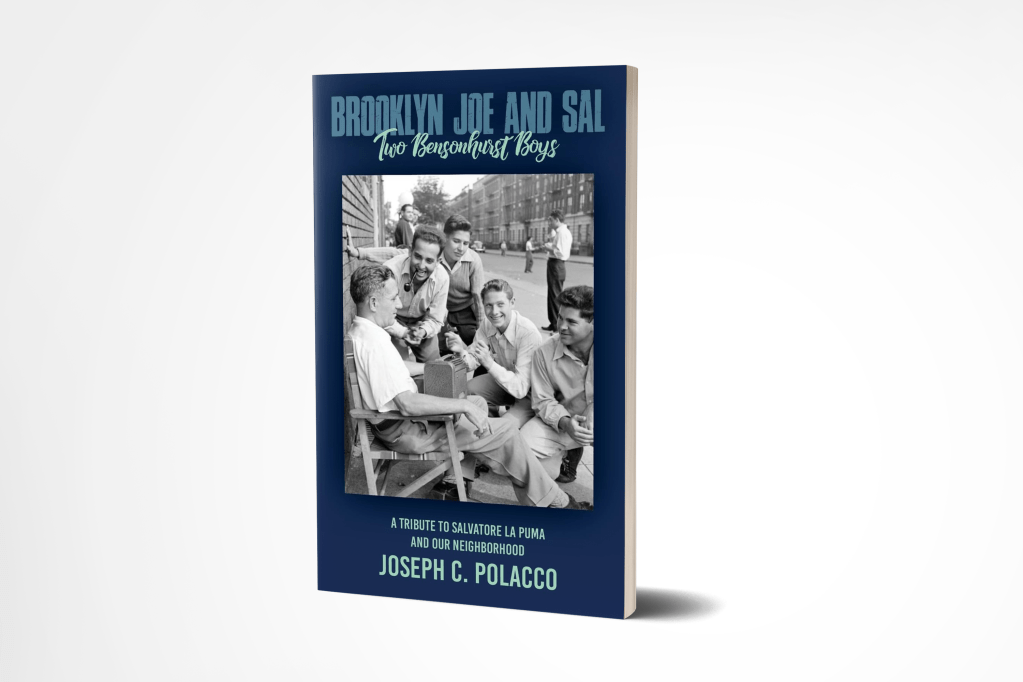
In his award-winning “The Boys of Bensonhurst,” Salvatore La Puma masterfully wove the lives of the hood’s sons and daughters, 1939-1943, just before I came on the scene in 1944. I partially came of age in Brooklyn’s Bensonhurst neighborhood whose inhabitants, not far from immigrant origins, were coming around to their new American identity. They were mainly Jewish and Italian, as evidenced by the accents, food, customs and religious practices that surrounded me. “Jewish and Italian” labels are too broad. There were finer divisions: Among the Jews, Litvak, Galitzianer, and Mizrahim, from Orthodox to Reformed. Italians self-identified as Sciacchitano, Palermitano, Napoletano, et al., distinctions that were often fiercely defended.
In La Puma’s story lines, and through my youth, relationships were heavily influenced by Church, Synagogue, European origins, the mob, family, and cohorts within and between each side of the religious divide. (La Puma was wise to paint the schism as simply Jewish vis-aĚ-vis Sicilian, though he described “commerce” across the divide.) La Puma’s stories are a backdrop to my own stories of halting maturation, from a Bensonhurst Boy to a (hopeful) man well beyond the neighborhood. Like La Puma’s boys, I did not always follow lessons learned the hard way. Yet Bensonhurst was my launch pad and is still my ground control, offering perspectives throughout my life’s trajectory.
Travel along with my Bensonhurst and post-Bensonhurst adventures. I survived to weave a story that skirted the wise guys, street characters, and my own ill-advised actions. But, I was lucky, and family was ever present. And I rejoice in the hold that Bensonhurst still has on my life.
86th Street in the early 50’s (below) I did not appreciate how blessedly unique was my youth. The Williamsburg Bank branch on the corner of 23rd Avenue was a Taj Mahal peering over the teeming, mostly immigrant mix, as if a tropical flower pushed up through the rich loam of the ’hood. Cross under the West End “el,” to find my home behind Greg’s Floor Covering (2238 86th Street).

Brooklyn Joe and Sal, Two Bensonhurst Boys Available Online

Amazon

Barnes and Noble
Brooklyn Joe and Sal, Two Bensonhurst Boys Available Locally

D&H Drugstore

Skylark Bookshop

Yellow Dog Bookshop
What Others Have Said About “Brooklyn Joe and Sal, Two Bensonhurst Boys”
Joe Polacco’s story is a must read for anyone wanting to know what it means to come of age in a rough and tumble post-World War II American city. His neighborhood, Brooklyn’s Bensonhurst, was full of people not far from immigrant roots. Joe brilliantly shares how his Bensonhurst boyhood shaped his life’s experiences from street stickball to the heights of the American dream. Throughout, that trail gives truth to the shibboleth that you can take the boy out of Bensonhurst but you can’t take Bensonhurst out of the boy.
—David Cohen, New York City Police Department, Deputy Commissioner, Intelligence (retired)
Just as the Brooklyn Dodgers departed from New York (in the dark year of 1958), so did Joseph C. (Joe) Polacco leave to pursue a career and opportunities elsewhere. Nevertheless, his beloved Brooklyn is imprinted in his emotional and cultural Italian American DNA. This is evident in his stories of growing up in the 1950s in a Brooklyn ethnic enclave.
The author intertwines his writing with those of Salvatore LaPuma—to whom the book is
dedicated. Both wrote about the author’s Bensonhurst neighborhood. As you read Joe’s stories, you will be brought back—transported to Brooklyn the way it was for those of us who grew up in an Italian-American or ethnic neighborhood like it.
—Salvatore Primeggia, PhD., Professor of Sociology, Adelphi University, Specialist in the Italian American Experience
Joe Polacco, you’re a wonderful writer. I was back in the neighborhood, sitting on the porch and waiting for grandma’s fried artichokes. Thank you so much, Joe, for the journey.
And, reader, if you missed growing up in Brooklyn (or at least visiting the place every Sunday afternoon), then you missed some of the best parts of life. Pigeons racing overhead, fig trees wrapped carefully in tar paper and buckets on their head to overwinter, pre-Civil War wrought iron fences that were perfect for running sticks over. Each block a new neighborhood, a new country, a brave new world of foods, and smells, and music. Radios blaring baseball play-by-plays, while men argued and played pinochle after the meal of pasta, beautiful salads, and homemade bread, and the women went to the park, where carousels and stickball and handball and everyone else’s families had gathered to start the week. Open this book and you can taste the tomatoes, hear the arguments, bemoan local politics, and feel the hugs from people you just met. It’s a gift.
—Mary Barile, Author, Playwright, and Granddaughter of Brooklyn
 Joseph C. Polacco - Author